11.4.11

CRUCIBLE STORIES: THE MASTER

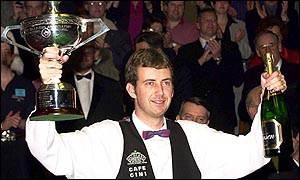
He may not be playing at the Crucible this year but no reminiscence about the World Championship is complete without mention of Steve Davis.

It is now 30 years since he won the world title for the first time, 30 years since his manager, Barry Hearn, barrelled across the Crucible stage and nearly knocked him over, 30 years since they cemented in the public mind a partnership that would conquer new ground for the game.

Davis first played at the Crucible in 1979. James Callaghan was still prime minister and Jimmy Carter was in the White House.

On that debut appearance, and perhaps unused to such long matches, Davis felt peckish and so had a ham sandwich delivered to the arena. These were more innocent times but he was still accused in the press of not giving the game enough respect.

Steve Davis not giving the game enough respect! Is there anyone, anywhere in the world with a deeper love for and fascination with snooker?

His other love was, of course, for winning, which he very quickly set about doing after his initial 13-11 defeat to Dennis Taylor.

In 1980, Davis beat the defending champion, Terry Griffiths, for the first of seven times at Sheffield before losing 13-9 to Alex Higgins.

By 1981 he was UK champion and an obvious world champion in the making. Davis was a shy man but part of a brash, ballsy group from Essex, led by Hearn, and the ‘Nugget’ seemed to relish being part of a team in what was, and remains, a peculiarly individual sport.

That year Davis beat Jimmy White, Higgins, Griffiths, Cliff Thorburn and, in the final, Doug Mountjoy to win his first world title.

This was a gruelling route to glory. It’s fashionable to look back at this era as being somehow low in standard. It wasn’t. These guys were hard match players still playing for a meagre living. They gave you nothing and you had to scrape them off the table.

Cloths were thicker and balls were heavier. Break building was tough and the game was full of arch tacticians.

Hearn, who had been introduced to Davis in one of his clubs in the 1970s, possessed an entrepreneurial spirit that could thrive in an era where television was putting snooker front and centre. The pair made serious money in endorsements, exhibitions and personal appearances.

But it all took its toll on Davis that first year. Exhausted, he fell 10-1 to Tony Knowles in the first round in 1982.

The titles kept coming, though. He was by now clearly the best player in the game and in 1983 swept through the field – a 13-11 defeat of Taylor in the second round his only close match – beating Thorburn 18-6 in the final with a session to spare.

In 1984 he lost a 12-4 lead over White but still beat him 18-16 in the final. Davis went into the 1985 championship as a racing certainty to land a fourth world title.

But we all know what happened in the final. And his defeat to Taylor opened up a crack in his confidence that clearly played a role the following year when Joe Johnson beat him 18-12.

Even in 1987 it was close, Johnson recovering from 14-10 down to just 14-13 before Davis won 18-14.

And in 1988 he led Griffiths 5-2 but, after being hauled back to 8-8, was fearful of another turnaround. On the morning of the last day, Davis went for an early morning walk around Sheffield to clear his head. He won 18-11.

In 1989 he blew away John Parrott 18-3, the heaviest defeat inflicted on any player at the Crucible, and stood on top of the snooker world, its imperious, all conquering top dog.

But, inside, Davis was not happy with his game and he was also aware that Stephen Hendry was biting at his heels.

As one decade ended and another began, so a new snooker era would dawn, dominated first by Hendry and then by three outstanding talents: John Higgins, Mark Williams and Ronnie O’Sullivan.

Snooker had changed. The boom Davis led had created a string of talented young players, all of whom looked instinctively to attack. Standards rose and many of the old guard were simply left behind.

Back in 1981, there were 13 centuries recorded at the Crucible. Last year there were 61 – itself 22 fewer than the record.

When the 1990s began Davis was still better than almost everyone but Hendry overtook him in the rankings, White beat him in the 90 semis, John Parrott in the last four in 91 and, the following year, he was humbled in the first round by Peter Ebdon.

Even so, he was still winning titles and went into the 1994 championship knowing that if he went further than Hendry he would return to no.1 spot in the official world rankings.

They met in the semis – what a shame they never contested a Crucible final – and Davis led 9-8 before Hendry pulled away to beat him 16-9.

Davis managed one more quarter-final appearance until he was relegated from the top 16 in 2000. For two years he failed to qualify but returned in 2003.

I remember him sitting in the pressroom in Malta a couple of months before the 2005 championship, the last to be sponsored by Embassy.

He said he didn’t really practise much but that he would be putting the hours in for the World Championship, out of deference to the departing Imperial Tobacco.

Davis duly reached the quarter-finals at the age of 47, an admirable feat in its own right but what followed last year topped it ten fold.

It wasn’t just that he beat John Higgins, it was the way he did it, playing some of the frighteningly hard snooker he employed to put so many opponents to the sword in the 1980s.

The reception he got afterwards was proof of the esteem in which he is now held as the game’s elder statesman.

It all ended against Neil Robertson and it is a great irony that the changes Davis and Hearn have introduced have hastened his decline.

The PTCs are for younger, hungrier players. Davis is sliding down the rankings and, though I suspect he will carry on, it’s hard to see his career continuing for too much longer.

Yet to update a famous Davis quote, it's all there in colour: his triumphs and his glories, the titles and the trophies. As long as people talk about snooker, they will talk about him.

At 53, it seems likely that Steve Davis has walked off the Crucible stage for the last time.

But hasn’t he left us with some wonderful memories?

8.4.11

CRUCIBLE STORIES: TOIL AND TROUBLE

It seems to me Ronnie O’Sullivan is like Macbeth. Don’t worry, I’m going to explain what I mean.

Historically, Macbeth was by far Shakespeare’s most popular play. If a theatre was running it then it was a sure sign that they were in financial trouble and desperate for an audience, hence it became regarded as unlucky to even mention its name.

Similarly, journalists hard pressed to get any sort of snooker stories in the newspapers know that they can rely on O’Sullivan’s name and profile for some column inches.

At this week’s launch of the Betfred.com World Championship he was not present. He was going to be invited but such has been his de-motivated demeanour this season that it was felt to be a bad idea.

But this didn’t stop most of the stories being about him. Regardless of his on and off table problems he remains box office, even though most of us have heard it all a million times over. I don’t blame the hacks for this. It was very likely O’Sullivan or nothing for many papers.

Ronnie’s Crucible record is a little like his career in general: the good, the bad and the ugly.

He qualified in his very first season and has not missed a year since. The first real headlines he created at the Crucible were for all the wrong reasons when he assaulted a tournament official in 1996.

He should have been thrown out of the tournament but was allowed to play, beat John Higgins in a 13-12 thriller and lost in the semi-finals to Peter Ebdon.

A year later he looked a new man: slimmed down, full of confidence, he compiled his remarkable 147 break in just five minutes, 20 seconds.

This remains an exhibition of sheer genius. Technically, it was superb and the speed at which it was constructed was testament to O’Sullivan’s instinctive brilliance for the game that no other player has matched.

But he didn’t win the title and indeed saw his contemporaries Higgins and Mark Williams get their hands on the famous old silver trophy before him.

It didn’t help that he found players playing world beating stuff against him: Higgins in the 1998 semis and Stephen Hendry at the same stage a year later. In 2000 he made five centuries in his first round match but still lost 10-9 to David Gray.

Before the 2001 final, in which O’Sullivan would play Higgins, there was a ‘parade of champions’ that – ludicrously – included Jimmy White. O’Sullivan watched his good pal, a six times runner-up, receive his ovation and resolved never to be in that position.

There was some great snooker played in that final. O’Sullivan stood up to everything Higgins threw at him and won 18-14. It was the fulfilment of a snooker destiny.

And then a year later it was more negative press, this time for his ill advised, ungracious verbal attack on Hendry shortly before their semi-final.

2003 saw O’Sullivan make a second Crucible maximum but still lose in the first round to Marco Fu.

By 2004 he was working with Ray Reardon, a master tactician but also someone with the utmost respect for the game of snooker. He instilled some discipline in O’Sullivan. It was noticeable just how much he practised ahead of that year’s championship. At all the tournaments leading into it he seemed to be working on stuff with Reardon and it paid off, he won a second world title.

Always, though, O’Sullivan was walking an uncomfortable tightrope. He loved snooker and yet he hated it. He was tormented by the fact that even playing well did not rid him of his other demons, which were, indeed still are, deep set.

This is why he has so often threatened to retire but never actually gone through with it: snooker is not the answer to his problems but neither is giving up snooker.

In 2005 he lost an infamous quarter-final to Peter Ebdon, whose go-slow tactics precipitated a full scale breakdown in the arena.

A year later he suffered another against Graeme Dott, who resolutely refused to be put off by some bizarre behaviour, including a fixation with tips and some curious mugging to one of the TV cameras.

A third 147 in 2008 led in to a third world title, although he still put a downer on it afterwards by – yet again – raising the prospect of packing in.

Last year he was out-foxed by Mark Selby. This year...who knows?

Barry Hearn, understandably, has told the media that O’Sullivan is not much good to the sport if he’s not trying or can’t be bothered.

But it would be ignorant to assume that O’Sullivan wants to be in this position. I’m sure he’d rather be happy and playing well, but life isn’t like that at the moment and that doesn’t bode well for his 19th Crucible campaign.

Having observed O’Sullivan at close quarters at the Crucible I would say he has consistently been put under far greater pressure than the rest, purely because of his pulling power.

There was one year there where he made an off colour gesture caught on camera. He was wrong to do it but the press coverage suggested he had been guilty of some great crime and he was later accused of behaving badly when he simply hadn’t – leading him to walk out of a post match press conference before it had barely begun, genuinely upset.

It’s easy to say that this is part and parcel of being a sportsman, but there’s enough pressure at the Crucible as it is without having things written about you which aren’t true.

Yes, there have been times when he hasn’t helped himself but also times when he’s been misrepresented. No wonder he sometimes can’t wait to get home, away from the whole circus.

I’m not going to comment on Ronnie’s personal issues. They are private and for him to resolve.

But clearly his focus is not on tournament snooker. He has shown nothing this season to suggest he is going to win a fourth world title.

Will the Crucible inspire him? Many will hope so.

But, as ever, the spotlight will be on him, and now perhaps more than ever he’d rather it shone somewhere else.

7.4.11

CRUCIBLE STORIES: A NEW ERA DAWNS

It’s worth remembering that the prosperity professional snooker has enjoyed for the last 30 years was preceded by some hard times.

The World Championship stopped stone dead in 1957 through lack of interest and only achieved credibility again in 1969 when it became an open event.

In the 1970s, general public interest increased thanks to the emergence of Alex Higgins. The BBC gave fans a weekly snooker fix through Pot Black and in 1978 took the landmark decision to broadcast the World Championship in its entirety.

There was still not much of a living to be made and many players preferred to remain amateur but, in 1978, Terry Griffiths, a twice English amateur champion, was accepted into the professional ranks at the age of 31 and the world of snooker would change forever.

Griffiths hailed from Llanelli in Wales and had worked as a bus conductor, insurance salesman and postman who was 25 before he started playing snooker at a serious competitive level.

His first match was in the UK Championship, where his 8-2 lead against Rex Williams was whittled away until it became a 9-8 defeat.

He headed to Sheffield the following spring hoping merely to get some sort of profile from playing in the sport’s main event.

“My ambitions were quite small,” Griffiths told Snooker Scene in 2009 when we commemorated the 30th anniversary of his Crucible triumph.

“I went to the Crucible because I would be receiving national television coverage that would offer me the opportunity to get exhibitions, because this was the only way I could earn money. There were only two tournaments to play in.

“I was drawn against Perrie Mans in the first round, which was great because he had been runner-up the previous year.

“Then the technicians threatened to strike. I had a panic attack because I thought if I lost to Perrie I wouldn’t get any TV exposure and therefore wouldn’t get any work.”

However, Griffiths did not lose to Mans, he beat him 13-8, which meant a quarter-final against one of the title favourites, Alex Higgins.

The match was a classic. Higgins led 6-2 but Griffiths recovered to 8-8 going into the final session.

At 12-12, he made a 107 break for victory and a place in the semi-finals. As a result, the notion that a first time professional could win the title got a little less unlikely.

“I thought if I could beat Alex over a long distance, which was all new to me, then I had a chance of winning the title, but no more than a chance,” Griffiths said.

“If you’re in the semi-finals you have to think you have a chance but not in my wildest dreams did I expect to win the tournament at any stage until the last day.”

To get to the last day, Griffiths had to first make it past the dogged Australian, Eddie Charlton. Their semi-final was a marathon that ground on until 1.40am.

Griffiths had led 10-4 but, exhaustion beginning to set in, lost six successive frames and trailed 11-13 and 16-17 before a break of 97 in frame 36 secured his 19-17 victory.

It was in the arena afterwards that, asked how it felt by the BBC presenter, David Vine, Griffiths uttered the immortal words, “I’m in the final now, you know.”

His genuine humility and obvious working class credentials saw the public warm to him for the final against Dennis Taylor.

He was aware, though, that tiredness may still count against him in the three day, seven session, best of 47 frames final.

“I had a spell against Eddie in the semis and against Dennis in the final where I couldn’t really stand up. I was so tired. Luckily enough I had leads when those tired spells came along,” Griffiths said.

“I’d never played that much snooker at the practice table, let alone under match conditions with all the pressure and the television lights.

“For the Charlton match we went straight through from the afternoon to evening session without any real break and I lost a string of frames but somehow managed to win the match.

“I was ahead of Dennis and he was under pressure because I was the outsider. Nobody knew me.

“But I had a tired spell and hit a brick wall. He levelled up at 15-15 and the next day I got up and thought I could win the tournament. That was the first time I’d thought about it.

“I thought, this is it, I’m either going to be champion or runner-up, and I didn’t want to be runner-up. I just had a feeling I would win and went out and played exceptionally well on the last day.

“I ended up losing a stone in weight. It seems like a short tournament now but it really was a long championship.”

And then his life changed. From the struggling newcomer he instantly gained national fame as the snooker boom began to take hold.

“Winning the World Championship set me on the road. It also turned me into a nervous wreck,” he said.

“My ambition had been to get exhibition work through appearing in the championship but it sort of backfired in a way because I hardly had a day off for a year, or so it seemed.

“My diary filled very quickly. The game was booming at that time. It had had more hours than ever before on national television and I was always going up to London to do TV and various things.

“Clubs were after me for shows as well. It was all very strange to me, from humble beginnings to all of that.”

His life changed but so too did the snooker circuit. Interest from broadcasters and sponsors meant more tournaments and an intake of players determined to emulate Griffiths’s success.

“In those days, if Ray Reardon, Alex Higgins or John Spencer didn’t win the World Championship there was a steward’s enquiry,” he said.

“Me coming along did open the doors in other people’s minds. A lot of those who turned professional after that had competed against me in the amateur game and it would have inspired them to have a go at it.

“They may not have done otherwise because in those days there was very little chance of earning a living.

“But when we drifted into the 1980s the game blossomed. There were more tournaments, more opportunities and an actual living to go with your skill. Whereas before then if you didn’t get an invitation to Pot Black you couldn’t really make enough money.”

Griffiths was one of snooker’s leading lights throughout the 1980s and into the 1990s. He lost seven times at the Crucible in seven meetings with Steve Davis, who beat him 18-11 in the 1988 final.

Griffiths won the 1980 Masters at Wembley, the 1982 UK Championship, three successive Irish Masters from 1980 and attained a highest ranking of third.

His Crucible victory persuaded other talented amateurs, including Joe Johnson and Kirk Stevens, to turn professional. It proved the old order could be beaten and ushered in a new era for the game.

Griffiths is now a much respected coach. He retired in 1997 after losing 10-9 to Mark Williams.

But does he miss playing?

“There are odd times when I turn the clock back,” he said. “However, I only think that based on what I know now, what I’ve learned as a coach. I would have loved to have put that into my game when I was at my peak.

“That’s never going to happen but there’s nothing wrong in dreaming.”

6.4.11

CURSE WORDS

Let’s make one thing clear about the Crucible ‘curse’ afflicting first time champions: there is no curse.

Are we to believe some wizened old crone, blessed in the dark arts, decided back in 1977 to cast a spell on snooker players looking to defend the world title for the first time?

Frankly, winning any tournament two years running is difficult. John Higgins successfully defended the Welsh Open title this season. Prior to that it had been six years since anyone had done similar.

Only Steve Davis and Stephen Hendry have ever defended the world title at the Crucible.

Winning the thing once is hard enough, let alone winning it twice, let alone winning it two years running.

But it is true that first time champions go into their title defence under pressure. Becoming world champion means a huge hike in profile and thus demands on a player’s time.

Personal appearances, exhibitions, media work...they all take their toll and it’s hard to say no when ready cash is being thrown your way.

So it was that Davis was signing copies of his book in a Sheffield newsagent’s just a few hours before playing Tony Knowles in the first session of their opening round match in 1982.

Davis was shattered from an intensive – though highly lucrative – year of promotional work, lost the session 8-1 and the match 10-1. Take nothing away from Knowles but Davis had nothing left.

It’s a familiar tale: Dennis Taylor fell at the first hurdle in 1985, as did Graeme Dott in 2007.

Even Hendry couldn’t buck the trend, losing out 13-11 to Steve James in the 1991 quarter-finals.

Joe Johnson came the closest of any first time champion to completing a successful defence. After a dodgy start, he reached the final in 1987 and lost out only 18-14 to Davis.

Ken Doherty lost 18-12 to John Higgins in 1998, the only other first time winner to appear in the final the following year.

Neil Robertson faces Judd Trump on day one this year. This is surely the best opening match there has ever been at the Crucible.

Davis once summed up the pressure on the defending champion in typically sagely fashion: “The first shock hasn’t happened yet and it could be you.”

In a strange way, the fact Robertson is playing Trump, who has just won the China Open, may ease the pressure on him.

If he were to lose it would not be a huge shock, unlike, for instance, if he were playing some journeyman well down the rankings.

If he loses he could always blame it on the ‘curse.’

Well, if it really is a curse then it’s a good curse to have. It means you’ve done what most players could only dream of: you’ve won the World Championship.

5.4.11

CRUCIBLE STORIES: SEVEN UP

Stephen Hendry’s first round match against Joe Perry at this year’s Betfred.com World Championship will be his 86th at the Crucible, a record.

The stark facts are that it could also be his last.

Hendry needs a strong performance in Sheffield to keep his top 16 place. If he did drop out of the elite bracket he could of course regain it, but that’s if he has any appetite for playing in the qualifiers.

It wasn’t always like this. For a decade the Scot bestrode the world stage like the colossus he was.

You can teach technique and, to an extent, mental attitude but champions like Hendry are born and not made. There was some stubborn instinct inside him that made him determined to be the very best from a young age. Steve Davis was the same but I’m not sure anyone in the game has had it since.

By 1996 he was a six times winner of the World Championship and there were no obvious cracks appearing in his game. He won the UK Championship at the end of that year and was again a big favourite heading to Sheffield.

Hendry duly reached the final and there was no reason to suppose his era of dominance would come to an end. They always do, though, as John Major and the Tories found out a couple of days before Hendry and Ken Doherty contested the final.

Doherty was a fine player but also an intelligent one. He knew that if he played Hendry at his own game there would only be one winner and so did his best to keep him out, tie him up and generally stop him scoring.

And it worked. Hendry made five centuries and actually outpointed Doherty but lost the close frames and was beaten 18-12.

The question everyone wanted answered was whether this was a temporary blip or the signal that Hendry’s imperious reign at the top of the game was over. There were, after all, younger, hungry players of exceptional quality – John Higgins, Mark Williams and Ronnie O’Sullivan chief among them – who were winning titles.

The 1997/98 season was not Hendry’s best. Whispers began to grow in volume on the circuit that there may be problems, that he wasn’t the player he once was. They intensified at the Crucible when his old rival Jimmy White hammered him 10-4 in the first round.

I got the impression at that tournament that Hendry knew there was something wrong with his game but could not figure out what it was. I remember he and coach Frank Callan were relaxing in the pressroom between sessions of the White match, when Hendry trailed 8-1.

Frank turned to him and said, “the worst thing that can happen is that you can lose.” He meant it in a philosophical, worst-things-happen-at-sea kind of way but Hendry did lose, 10-4, and his manner afterwards suggested that this was indeed the worst thing that could happen to anyone.

The 1998/99 campaign began in a fashion that suggested not much had changed. Hendry’s 9-0 defeat by Marcus Campbell at the UK Championship made him face facts: something was wrong and had to be put right.

Through sheer hard work and strength of character he did put it right and would end the decade as a seven times world champion.

What was significant about his magnificent seventh is that nobody can say – at least with any credulity – that the draw opened up for him. His road to victory was possibly the toughest any champion has had to endure.

In the first round Hendry faced Paul Hunter, who had already won the Welsh Open and was very much a top player in the making.

Hendry didn’t score as heavily as usual and trailed 8-7 but managed to just raise his game enough to win 10-8.

Next up was James Wattana, not quite the player he was but still tough to beat. The Thai made two centuries and trailed just 9-7 going into the final session but did not win another frame.

The quarter-finals saw Hendry tackle Matthew Stevens, like Hunter a fast rising star who had already reached that season’s UK Championship final. Like Hunter and so many other younger players, Stevens had clearly modelled his game on Hendry’s. The challenge for the multi-world champion was to stay ahead of the pack, a little like running in front of a fast moving train.

But he did it. Hendry played a fine first session, winning it 6-2, and would secure a 13-5 victory.

And then in the semi-finals it was O’Sullivan, the flamboyant, precocious talent who was fast becoming a favourite with crowds in the wake of White’s decline.

Hendry led 6-2 but did not pot a ball in the next three frames and led only 9-7 going into Saturday.

The third session may well be the finest the Crucible has ever seen. Five centuries – three from Hendry, two from O’Sullivan, including a 134 to the pink – led Clive Everton to describe it as ‘snooker from the Gods.’

At 12-12 going into the final session Hendry needed one big effort. On a subconscious level he must have known that, with the younger talent around him, the chances to keep winning world titles were running out. That big effort was made. Hendry won five of the six remaining frames and reached the final with a 17-13 victory.

It didn’t get any easier. Mark Williams awaited, but Hendry took early control, winning the first four frames, led 10-6 after day one and won 18-11.

It was now beyond dispute: in the modern era he was the greatest. I interviewed him at the start of the following season and he said, “if I never win another title now it won’t matter.”

Of course, that very quickly went out of the window. Winning to Hendry was everything. Not dwelling on winning was one of the keys to his success.

Dwelling on losing may force him to think better of the whole thing and hang up his cue. I hope not because the standards Stephen Hendry set at the Crucible are still the ones everybody else in the game is aspiring to.

4.4.11

CRUCIBLE STORIES: HEADACHES AND HANDSHAKES

John Higgins and Mark Williams are seeded to meet in this year’s Betfred.com World Championship semi-finals.

They have played each other at this stage twice before and the matches were memorable for two incidents that had nothing to do with the actual snooker.

In 1999, Higgins was defending champion. He had won the race between his contemporaries Williams and Ronnie O’Sullivan to win the world title and overhaul Stephen Hendry at the top of the rankings.

O’Sullivan was brilliant but erratic, his personal life chaotic. Williams was thought to be the junior member of the trio (despite being the eldest) but was rising fast.

His dramatic 10-9 defeat of Hendry on a re-spotted black at the Masters in early 1998 was proof of a big match temperament and the following season he went on a remarkable run, finishing runner-up in the German Masters and then winning the Irish Open, Welsh Open and Thailand Masters.

Williams thus arrived in Sheffield as one of the four favourites – with Hendry, Higgins and O’Sullivan – to lift the trophy. All four made the semis.

My memory of Williams v Higgins has boiled down to one strange interruption on the Friday morning with the match around level. As I recall, Higgins was at the table when he noticed some liquid dropping down on to the table. He pointed up at the Crucible roof to the referee, Alan Chamberlain, who also noticed oil or water drip-dripping on to the baize.

Play was suspended while a humble towel was placed on the cloth to protect it.

I was backstage and it’s fair to say calm did not reign. Officials, technicians and other assorted bods busied themselves to find out what the cause was.

It created a major headache because the exact reason for the leak was not obvious. It allowed Clive Everton to reminisce on Radio 5 Live about the 1973 World Championship when rain – coming through a crack in the roof – stopped play.

Half an hour or so passed before the leak was plugged. It was put down to condensation, an explanation I’m not sure anyone really believed, least of all me and I wrote the press release. More likely it was oil from the TV lighting rig. Either way, I don’t think it ultimately affected the result. Williams, strong all season, won 17-10.

A year later it was Williams v Higgins in the last four again. Again, Williams had enjoyed a fine season, winning the UK Championship and getting to several finals.

But he lost six of the eight frames of the Saturday morning and trailed 14-10 going into the final session.

Williams spent the afternoon as any leading sportsman would: he went out and bought a ‘Billy the Bass’ dancing fish and tormented anyone he could find with it.

I recall the fish danced to Bobby McFerrin’s ‘Don’t Worry, Be Happy,’ which could perhaps stand as Williams’s anthem for life. Chilling in the pressroom, he did not bear the countenance of a man about to suffer a disappointing defeat in a tournament he had looked likely to win.

And so to the evening and an odd incident which would affect the result. The two players entered the arena but Williams walked to the table and broke off without shaking Higgins’s hand.

Knowing Mark, I have no doubt this was merely an oversight. He had probably been driven slightly delirious by five hours of Billy the Bass.

To Higgins, though, it felt like a snub and it knocked his thinking. He allowed himself to dwell on it just enough for it to affect his concentration while at the table and Williams, playing as if he had nothing to lose, started to claw back the deficit.

I don’t remember the Welsh left-hander making a string of big breaks but he played good, hard match snooker and potted the pressure balls.

He won 17-15 and then beat Matthew Stevens 18-16 from 13-7 down to win the first of his two world titles.

I asked him after the final how he would celebrate. He said he wouldn’t. This was not entirely untrue. Certainly he didn’t go wild in the aisles because that isn’t his style. Williams is now as he was then: an understated character for whom simple pleasures – family, old friends, cheerful good humour – outrank extravagance or self importance.

The defeat knocked Higgins back. It led to an anxiety about whether he would ever win the title and heralded a string of disappointing Crucible performances that were not resolved until he won again in 2007. He has, of course, now overtaken Williams on total titles.

That they are seeded so highly for the World Championship some 11 years on proves what great players these two are.

I sometimes think the semi-finals are too long but I’d happily watch Higgins v Williams over another four sessions this year.

THE CRUCIBLE COUNTDOWN

All that’s left this season, then, is the biggest tournament of them all.

From now until April 16 this blog will be counting down to the Crucible. If you’ve seen the ‘war’ edition of The Day Today then it’ll be a little bit like that. Nothing else will matter.

I will be writing a series called ‘Crucible Stories.’ These are reminiscences from the tournament over the years, however is not necessarily a ‘greatest moments’ countdown, more a collection of anecdotes, some personal, from the event’s recent past.

I will also be looking at a few stats in an attempt to predict what might happen on the table, but I’m not going to get too much into making a case for this player or that because you all know who the likely winners will be and why.

One thing I do believe: unless, for some unlikely reason, the conditions are bad, this year’s World Championship, coming off the back of a season of intensive action, will be one of the best we’ve ever seen.

There are a number of players playing really well and it means the 17 day snooker marathon will be not only as fascinating as ever but also a fine spectacle.

Let the countdown begin...

3.4.11

A STAR IS BORN

Judd Trump’s capture of the China Open title in Beijing today proves he is the real deal.

It was a wonderful final. Trump and Mark Selby compiled three centuries apiece, the tactical play was strong and there was some terrific long potting from Trump.

The 21 year-old thus becomes the youngest ranking event winner since Ding Junhui won the 2006 Northern Ireland Trophy at the age of 19.

Trump has long been regarded as a rising star. Now, he has arrived. This is very good news for snooker: a new, young face who plays the game in an entertaining way.

Part of his transformation has undoubtedly been moving to Romford. Trump practises at the Grove, also home for Ronnie O’Sullivan, Liu Song, Matt Selt and Jack Lisowski, with whom he also shares a house.

What is significant is that Trump is now standing on his own two feet. I’m sure his mother’s cooking is preferable to what he and Jack can conjure up between them but he has struck out on his own, an important step for any young adult.

He has learned not only about snooker but also about life itself.

Plus, he is getting a higher quality of opposition in practise to help him improve further than he would have got in Bristol.

His match with Neil Robertson on day one of the Betfred.com World Championship always looked tasty.

Now it pits the reigning Crucible champion against the winner of the last ranking event before the biggest tournament of them all.

What a way to start the 17-day marathon of the green baize.

SELBY V TRUMP

What a day for Judd Trump, the biggest of his young career.

He took the opportunity yesterday to hit back at those who had criticised him for not making faster progress.

Well, many people talk a good game but, unlike them, Trump plays one. He did so again yesterday in the semi-finals against Shaun Murphy, employing a mature approach and playing the percentages.

I’m pleased for Judd and his family, particularly his dad, Steve, who clocked up hundreds of miles on the motorways driving him to junior tournaments every weekend, toughening him up for competition.

Murphy was unhappy with all the cameras and phones going off. He’s right. It’s patronising to say that that’s the culture in China and the players should accept it. Spectators are specifically told – many times – to turn them off and should do so.

Mark Selby’s impressive fluency against Ali Carter only emerged in patches against Ding Junhui.

His semi-final victory took a long time to complete. Too long, in fact, for Ding who said afterwards that Selby’s slow play had done him in.

Actually, if a match goes scrappy or gets bogged down then it’s up to the player who doesn’t suit this style of play to force the pace or open things up.

So the China Open final is an intriguing battle between Selby, looking for his second ranking title, and Trump, seeking his first.

Both these players benefited from the commitment to the game of Malcolm Thorne, who ran all those junior events that gave them a chance to play and a chance to improve.

Malcolm died in January but he would be very proud to see these two lads going head-to-head in Beijing.

2.4.11

SO TO THE SEMIS

A fine week's snooker in Beijing has left us with four quality semi-finalists.

Mark Selby was yesterday superb. Positive, attacking and highly composed he produced one of his best performances of the season to beat Ali Carter 5-1.

Three centuries were testament to his heavy scoring. Now on 42 for the season, he is poised to join Stephen Hendry and Ronnie O'Sullivan as the only players to record 50 or more tons in a single campaign.

He's always been popular in China. I remember years ago after he played a match he spent a good hour or two in Cue Zone playing games of pool with some Chinese fans. That sort of thing goes a long way.

But, of course, his opponent will have most of the support. Ding Junhui, the champion in 2005, is through to the China Open semi-finals for a second successive year.

It was classy stuff from Shaun Murphy as he put John Higgins to the sword but despite those three top quality displays, the player who impressed me most was Judd Trump.

It was the big performance on the big stage we have been waiting for. He outplayed Peter Ebdon in all departments, including safety play, and took out the match with great poise.

Trump made an interesting admission in the week: that he had underestimated the quality of the players lower down the rankings when he first turned pro.

This was perfectly understandable. He was so used to winning as a junior that he must have felt he would carry on. All around him he was being talked up as the next big thing.

He's found the reality of life on the circuit different but has still done well - very well - for a player of his age.

Last season he earned just over £80,000. Not bad for a 21 year-old.

Some say "if you don't do it by 19, you won't do it at all."

It isn't true. Players mature at different rates. Ronnie O'Sullivan won his first ranking title at 17, Stephen Hendry at 18, John Higgins 19, Mark Williams 20, Shaun Murphy 22.

Age, though, is not the key but rather how quickly players learn the right way to play. Some take longer than others.

Trump has matured as a player and this suggests he can still make a breakthrough appropriate to his talent.

1.4.11

THE MAGNIFICENT, ER, EIGHT

You could make a reasonable case for any of the eight China Open quarter-finalists to win the title.

John Higgins, Shaun Murphy and Peter Ebdon are all world champions. Ding Junhui is a former winner while Stephen Lee, Mark Selby and Ali Carter have won ranking titles. Judd Trump is a fearsome talent and regarded as a dangerman by his fellow pros.

But the man to beat remains Higgins, as he has done since returning to the circuit last November.

His application and sense of purpose seems unshakeable and, allied to the best all round game of the era, it makes the Scot near unbeatable when he’s playing at his best.

I think John would admit that in recent years he wasn’t that bothered by the Chinese events. In fact, he only really got motivated by the bona fide majors.

The possibility of losing his playing rights has focused the mind, though. He now treats every frame of every match of every round of every tournament the same.

Murphy has come from behind twice in successive rounds to take his quarter-final place but doesn’t yet seem to be scoring as heavily as he needs to. However, he relishes the big occasion and the chance to put an end to Higgins’s great run may well inspire him.

Ebdon expertly undid Neil Robertson yesterday and will surely fancy doing the same to Trump.

Trump is often criticised for going for everything but he needs to play his natural game against Ebdon, rather than getting sucked into playing in a manner he doesn’t like and will come off second best in.

Lee has had a great week already and, to use the hoary old commentary cliché, his ‘Rolls Royce’ cue action has got him motoring towards his first major title in five years.

Ding – who turns 24 today – wasn’t at his best against Stephen Hendry but didn’t need to be. The seven times world champion, after a bright start against Matthew Stevens, reverted to more recent type and found it hard to take advantage of what chances came his way.

Selby v Carter is a repeat of the Shanghai Masters semi-final from earlier in the campaign. Carter is aiming to become the first player to do the Chinese double in the same season and if his match with Selby isn’t close I’d be surprised.

31.3.11

MARK ALLEN BATTLES DEPRESSION

Mark Allen has revealed he is battling depression.

The world no.11 is receiving professional help in a bid to combat the condition, which he believes has in part developed because of the nature of life on the circuit.

"We all live out of suitcases and, for me, it's just come to a head," Allen told the Irish Mirror.

"I suppose, if I look back on certain things in my career, this has been coming for a long time. But more recently I've really felt more down than I ever have.

"Some days I wake up and I just can't be bothered, I don't have the motivation to do anything.

"It does get very lonely when you're looking at the four walls of a hotel room for most of the year.

"I've been a professional for a few years now and all I've done since then is play snooker, I've known nothing else.

"If I knew what the problem was then I would have sorted it, but I've been seeing a counsellor to see what the problem is.

"It helps to talk about how I'm feeling because when you're on the road, or at a tournament, you don't really have the chance to tell anyone how you're feeling.

"I'd say I get on with 99 per cent of the other players, but to be honest everyone has their own routines and being a snooker player is a very lonely life."

More particularly, snooker is an individual sport. Yes, the players have people in their corner but no team-mates to share the load.

Snooker is also intense. It moves slowly and although it doesn't take huge physical effort, it requires immense mental energy.

Ronnie O'Sullivan, most famously, has suffered from depression for many years. More recently Graeme Dott has also received treatment for this much misunderstood condition.

I listened last week to Geoffrey Boycott, the former England cricketer, giving his ill informed views about a player who had been diagnosed with depression. It was clear some people still think it's a case of 'just cheer up.'

That's a bit like telling someone with a broken leg to go and run a marathon.

I'm not that surprised by Allen's revelation. Down at the Championship League he was very subdued and spent most of his time while not playing staring at films on his laptop but seemingly not really watching them.

I understand he simply couldn't get on the plane to play in the Hainan Classic.

It's a sad situation for such a talented young man to find himself in. I hope he can get through it and rediscover his joy not just for snooker but for life itself.

DING V HENDRY: THE BEIJING RE-MATCH

Ding Junhui's remarkable 9-5 victory over Stephen Hendry in the 2005 China Open final spearked the snooker boom that has enabled the game to expand into China.

Ding turned 18 that week and a star was born. Very quickly he won two more ranking titles before his demoralising defeat to Ronnie O'Sullivan in the 2007 Masters final and the general level of expectation on his young shoulders caused him to take two steps back.

He turns 24 tomorrow and will play Hendry again later today for a place in the Beijing quarter-finals.

Hendry is not the player he was then but produced a first rate display to whitewash Matthew Stevens on Monday and, battling for his top 16 place, remains dangerous.

Ding should probably have lost to Kurt Maflin but it's often the case that players who survive a first round scare grow stronger as they make the most of their reprieve.

Judd Trump reached the semi-finals of the 2008 Grand Prix but has done little of note since on TV. He admitted yesterday that this had got under his skin but, at 21, there is obviously time to turn things round.

He will need his wits about him, though, against Mark Davis, a highly experienced player full of confidence who played very solidly to see off Stephen Maguire.

Neil Robertson has, surprisingly, never been to a quarter-final in China and has lost to Peter Ebdon there twice in the last year.

Ebdon, who won this title two years ago, remains reliably tough, although inconsistent. One thing that has always played on his mind is the playing conditions and they have been superb this week.

Ricky Walden has beaten John Higgins twice but both victories came over six years ago and Higgins, though not at his very best, competed well against Nigel Bond yesterday.

Mark Selby got sucked into yet another grind against Tian Pengfei but ultimately came through and should find his contest with Robert Milkins to be more free flowing.

Ryan Day beat Ronnie O'Sullivan for the second tournament running. O'Sullivan played as if it were an exhibition - he even wore his exhibition shirt - and looked thoroughly bored and dispirited in the press conference afterwards.

Maybe the Crucible will inspire him but he is clearly out of love with snooker, or at least proper competition snooker, right now.

Day faces Stephen Lee, him of the miracle 5-4 win over Mark Williams earlier in the week.

Wildcard Li Hang has already beaten two world champions - Ken Doherty and Graeme Dott - and now faces another, Shaun Murphy, who, like the other two, is on a hiding to nothing.

30.3.11

THE JOHN AND RONNIE SHOW

An extraordinary day's snooker in Beijing on Tuesday saw Mark Williams make four centuries and still lose 5-4 to Stephen Lee, who made one of the finest clearances imaginable to win the decider, including the final black using the rest.

Meanwhile Ding Junhui roared back from 4-1 down to beat Kurt Maflin 5-4, Shaun Murphy recovered to defeat Joe Perry and Marcus Campbell edged out Mark Allen in a decider.

Mark davis played really well to beat Stephen Maguire while Chinese wildcard Li Hang landed the scalp of a second successive world champion as he followed his defeat of Ken Doherty by beating Graeme Dott.

All this and John Higgins and Ronnie O'Sullivan are yet to play. The duo enter the fray today. Higgins will be heavy favourite to beat Nigel Bond, a man respionsible for inflicting on the Scot one of his most disappointing defeats.

It came in the final of the 1996 British Open in Plymouth. Bond needed a snooker in the deciding frame, got it and won on the black.

Higgins has been so focused and so relentlessly reliable since his return from his suspension that he has to be favourite to win in Beijing this week.

But despite the season he's had, you can never count out O'Sullivan's chances. He has looked demotivated and disinterested for much of the campaign but if he's in the mood, he can still turn it on.

It's good news that he's travelled to China at all. He always draws a huge crowd there. Then again, he went last year and didn't seem to try.

Ryan Day beat him in the Welsh Open and, like Lee and Matthew Stevens, seems to have rediscovered some form of late.

So some great stuff so far and I've no doubt it'll continue today. Things are bubbling up nicely for the greatest test of them all just around the corner...

29.3.11

VINTAGE HENDRY

Stephen Hendry was the star of the show on day one of the Bank of Beijing China Open, beating Matthew Stevens 5-0 in just 66 minutes.

Stevens has been in great form of late but Hendry limited him to just nine points during a performance reminiscent of his peak.

He began with a century - as he often seems to - but, this time, kept it going rather than immediately fizzling out.

Just as one swallow doesn't make a summer, so one excellent performance doesn't mean he is suddenly back to his best but it must have given him great heart.

Hendry has always performed well when his back is to the wall: 8-2 down to Mike Hallett in the 1991 Masters final, 14-8 down to Jimmy White in the 1992 world final and even 9-7 down to Zhang Anda at the Crucible last year.

Now, he knows he needs a good finish to the season to retain a place in the elite top 16. Maybe that will spur him on to end the campaign strongly.

Stephen Lee has not had the best draw for either of the last two tournaments of the season. He has John Higgins to look forward to at the Crucible and today faces Mark Williams, the defending champion, in Beijing.

Lee has played very well this season but Williams clearly has his mojo back. His victory over Ding Junhui in last year's China Open final was his first in a ranking tournament in four years. He has since won the German Masters and came within a whisker of landing the UK crown.

Joe Perry is one of those players well capable of causing an upset against Shaun Murphy, whose Twitter updates suggest he has found sleeping difficult in Beijing.

Similarly, Mark Davis could cause Stephen Maguire problems, particularly as Maguire's pre-tournament focus has been - happily - affected by the arrival of his third child.

27.3.11

CHINA IN THEIR HANDS

The tournament that immediately precedes the World Championship is traditionally overshadowed by it, for no other reason than its slot in the calendar.

Inescapably, everyone is talking about the Crucible and the players are thinking about it, at least those who have qualified are. It is 13 years since the player who won the last title before Sheffield triumphed in the World Championship itself.

It's better now than is used to be when first the British Open, then the Scottish Open took place just a week before the Crucible.

And the Bank of Beijing China Open has grown in prestige, now offering a first prize of £60,000.

This tournament went into abeyance for three years until 2005 when World Snooker staged it again on a one-year deal. To their great relief it was won by Ding Junhui and has since been fully funded by the Chinese organisers.

The one downside to this is that they still insist on Chinese wildcards, whose continued presence in the event is unfair on those who have battled through qualifying.

For instance, Kurt Maflin won four matches in Sheffield to secure his TV debut but now has to play Cao Yupeng before he can take on Ding.

At least the organisers have seen sense this year by putting on two first round matches on the opening day. Stephen Hendry faces the in form Matthew Stevens while world champion Neil Robertson faces Barry Hawkins.

There will be no Jimmy White, though. Apparently White travelled to China on a single entry visa but then went to Thailand for exhibition work which meant he was not allowed back into the country.

This gives wildcard Tian Pengfei a walkover to play Mark Selby in the last 32.

Eurosport - who don't select which matches appear on the two main TV tables, just to head off that annual moan - will be showing live action on both its channels all week, although this varies depending which country you live in, so check local listings.

It's an interesting line-up and, despite its proximity to the World Championship, will doubtless be won by one of the usual suspects.

John Higgins, who won the recent Hainan Classic, has to start favourite again as he hunts down a fifth title of the season.

It looks like Ronnie O'Sullivan will be playing, but he is in a brutal quarter of the draw and starts out against Ryan Day, who beat him at the Welsh Open.

Local support will be for Ding, who finished runner-up to Mark Williams last year.

25.3.11

STEVENS BACK WHERE HE BELONGS

So Matthew Stevens will be in next season's Premier League after his 3-1 defeat of Shaun Murphy in the Championship league final last night.

It marks the latest step in what has been an excellent few weeks for the Welshman: a Welsh Open quarter-final, last gasp win over Fergal O'Brien in World Championship qualifying and semi-final spot in the PTC Grand Finals.

Stevens dropped out of the top 16 in 2007 but will be back for the next seedings cut-off point. Good. It's where a player of his ability and class should be.

He was one of the young stars, along with Paul Hunter and Graeme Dott, who turned pro in the wake of O'Sullivan/Higgins/Williams in the mid 1990s and became leading players.

Stevens, like Jimmy White, is unfairly talked about in the main for what he hasn't won rather than what he has.

It is fact, of course, that he has lost two close world finals, both of which he could have won, as well as three close Crucible semi-finals.

However, little is made of the close Masters and UK Championship finals he won.

If you read Snooker Scene's interview with him at the start of the season you will know he made a concerted effort this year to apply himself.

Like Stephen Lee, another player of proven quality, he has found the changes in snooker to have helped him rediscover his form.

Put simply: he is playing so often that he has been able to sustain this form for a lengthy enough period to achieve meaningful results.

I'm glad he's doing well again, not just because I enjoy watching him play but because he is a nice guy who has taken a couple of serious off table knocks.

Matthew's father, Morrell, died in 2001. He was his biggest supporter, travelling everywhere with him.

“It took me at least two years to come to terms with him dying,” Stevens told Snooker Scene.

“I couldn’t face up to it. I didn’t want to practise and I was just going out drinking all the time, trying to block it out.

“The last thing I wanted to do was play snooker. He used to go to every tournament with me and it just didn’t feel the same. It still doesn’t.”

Then, in 2006, his best friend, Hunter, lost his long, painful battle with cancer, another devastating blow which must have had an effect on his game.

And what of the various close defeats? Have they formed an edge of uncertainty that has made winning further close games more difficult?

“It’s hard not to think what could have been," Stevens said. "I’ve lost so many close matches at the World Championship and I do find myself replaying certain shots in my mind.

“I remember missing a black off the spot when I was well ahead against Mark and he was brilliant after that. I thought I played well against Shaun but he was inspired.

“It’s tough to take but you can’t change anything. That’s how sport is.”

Indeed it is and the future is suddenly much sunnier.

Stevens is off to China tomorrow. His only problem is that he has been playing so much that he has been unable to obtain a visa and so has had to drive to Manchester to get one today.

Like most other things he has taken this in his stride. He is just happy to be back where he belongs.

23.3.11

THE BIG INTERVIEW: JIMMY ROBERTSON

There are two Robertsons at the Crucible this year. Neil, of course, is defending the Betfred.com World Championship title.

Jimmy Robertson, on the other hand, is an unknown quantity whose run to the final stages came out of the blue – certainly for him.

“I was ill in bed a few days before the qualifiers,” he said. “It was one of those flu like things where every part of my body ached. I didn’t expect much when I got to Sheffield but seemed to play well from the start.

“I’m just really happy. My phone was non-stop with calls and texts afterwards. Hopefully this will be the first time I’m at the Crucible but not the last.”

After tight wins over Xiao Guodong (10-9) and Tony Drago (10-8), Robertson faced the vastly experienced Ken Doherty in the final qualifying round.

Doherty, champion in 1997, led 6-3 at the halfway stage and logic dictated that, with all his years in the game, he would close out victory.

“I didn’t have that much to lose. Ken would have been favourite but I felt I played all right in the first session, even though I was behind.

“My aim was to win three of the first four frames and get it back to 7-6 but in fact I won all four, he started missing and I managed to come through.”

Robertson, who turns 25 the day after this year’s World Championship ends, began playing at the age of eight and also pursued a career as a junior football and had trials for Crystal Palace before snooker won out.

He first turned professional in 2002 at the age of just 16 after winning the WPBSA’s junior play-offs, one of the varied paths to joining the main tour that have been employed over the years.

He won his first ranking event match but failed to win another and was immediately relegated.

Robertson was perhaps too young for the big time but his game was also severely hampered by a mysterious attack of the shakes.

“I had it for three or four years,” he said. “Everyone gets a little shaky when they are nervous but I found myself shaking when I was practising on my own.

“I couldn’t understand what it was or why it was happening.

“I went to see a specialist, who said it may have been a condition called dystonia, which causes your muscles to go into spasm but it could also have been because I was doing weights at the gym.

“I stopped doing them, talked it over with a few people and eventually it went away.

“I didn’t talk about it for ages because it was embarrassing for me. I was shaking so much that I couldn’t hold my cue properly and could barely see the balls.

“I thought people were looking at me, wondering what was going on. After it cleared up, though, my snooker started improving.

“I still get the odd shake now and again but it’s nowhere near as bad as it used to be.”

Robertson, who won the English amateur title in 2009, owns a snooker club, O’Sullivan’s in Bexhill-on-Sea, which his parents run for him when he is at tournaments or practising.

They will have to undertake a few more shifts come April 16. He has never been to the Crucible to watch but, alongside this year’s other debutant, Andrew Pagett, will become one of 179 players to have competed there since the World Championship moved to Sheffield in 1977.

22.3.11

HEARN'S GLOBAL VISION GATHERS PACE

The much trailed World Cup has been confirmed for Thailand from July 11-17.

It will feature 20 two-man teams. The players for each team will be selected according to their ranking position.

For example, if the current ranking list were used this would mean John Higgins and Stephen Maguire for Scotland, Mark Selby and Shaun Murphy for England and Mark Williams and Matthew Stevens for Wales. Thailand, as host nation, will have two teams.

The event will be sponsored by PTT, the state-owned energy company, and EGAT, the electricity generating Authority of Thailand. It takes place at the World Trade Centre in Bangkok.

Barry Hearn travelled to Thailand last week to finalise details, the latest in a long line of innovations his stewardship of World Snooker has brought about in the last year.

And it gets better. World Snooker says it is in advanced discussions for a new ranking tournament outside the UK in late July. I understand this could turn out to be in Australia.

That would be a huge step forward. An Australian Open was announced way back in 1989, the only snag being that it ended up being played in Hong Kong.

Hearn clearly believes that snooker’s future rests on its global potential, which has never been properly realised.

So many countries – Canada, Dubai, Belgium, Holland and Thailand to name a few – have been visited and then dumped by previous administrations.

We saw huge crowds in Berlin for the German Masters and the last two days of the PTC Grand Finals in Dublin proved snooker is still popular in Ireland.

At this rate there will be at least ten ranking tournaments next season, plus various invitation events, including the new Brazilian Masters, and the World Cup, a picture so rosy as to have been unimaginable just two years ago.

Not content with all this, Hearn has turned his attention to Killing Cancer, a charity the governing body will support by helping to raise £250,000 over the next three years.

Surely all Barry will soon have left to tackle will be world peace...

21.3.11

CRUCIBLE DRAW MADE

Neil Robertson will start the defence of his Betfred.com World Championship title against Judd Trump at the Crucible on April 16.

The first round draw was made this morning:

Neil Robertson v Judd Trump
Marco Fu v Martin Gould
Graeme Dott v Mark King
Ali Carter v Dave Harold
Ding Junhui v Jamie Burnett
Peter Ebdon v Stuart Bingham
Stephen Hendry v Joe Perry
Mark Selby v Jimmy Robertson
Mark Williams v Ryan Day
Jamie Cope v Andrew Pagett
Mark Allen v Matthew Stevens
Stephen Maguire v Barry Hawkins
Shaun Murphy v Marcus Campbell
Ronnie O'Sullivan v Dominic Dale
Ricky Walden v Rory McLeod
John Higgins v Stephen Lee

At first glance, the two form players this season, John Higgins and Mark Williams, have been handed tough opening round ties.

However, neither Stephen Lee nor Ryan Day would have wanted to draw them. Lee has long regarded Higgins as the best player in the game and the form the Scot has shown this season means he remains favourite for the title, even though the Trowbridge man is playing much better this season than he has for a couple of years.

Robertson v Trump should ensure an entertaining start to the championship.

Ronnie O'Sullivan has a good record against Dominic Dale but Mark Allen is unlikely to be doing cartwheels at the prospect of meeting an in form Matthew Stevens.

The two rookies, Jimmy Robertson and Andrew Pagett, will just be happy to be there. Robertson has a very tough match against Mark Selby but Pagett may fancy his chances against Jamie Cope, who tends to blow hot and cold.

20.3.11

SHAUN'S SHOW

Shaun Murphy’s capture of the inaugural Players Tour Championship Grand Finals tonight was just rewards for a player for whom playing snooker is never a chore.

Murphy topped the PTC order of merit. He played in some events even after it was clear he had qualified for Dublin.

I like to see those who make the effort to show up, even when they don’t have to, receiving the spoils. Murphy fully deserves his £60,000 winner’s cheque.

His best performance in the tournament came at the quarter-final stage when he recovered from 3-1 down to beat Stephen Lee 4-3.

These were three world class frames from Murphy. He played superbly and did not lose a frame thereafter.

Bad luck to Martin Gould but a career best cheque for £25,000 will be some consolation.

Gould will be back in action on Monday morning in another Barry Hearn promotion, the Championship League (I’m guessing Martin won’t be calling for any future EGMs).

And so the first ever PTC series is over. The final was watched by a huge crowd in Dublin and clearly it is here to stay, presumably with a few tweaks here and there.

At the end of the day it’s more snooker, and that is to be welcomed...Championship League, China and then the Crucible, the next few weeks are full of green baize action.

19.3.11

ALL GOULD

Hats off to Martin Gould for reaching his first televised semi-final in Dublin today.

Gould beat Michael Holt 4-2, winning a scrappy fourth frame on the pink before making breaks of 96 and 100 to ease into the last four.

The Players Tour Championship Grand Finals came along just at the right time. Gould has just qualified for the Crucible and will be in Beijing too so has every reason to be full of confidence.

His deadpan demeanour belies an extremely attacking game. I note he'swatched back the first two sessions of his second round match against Neil Robertson but not the last, in which he'd lost eight of the nine frames.

This is what's known as taking the positives, and a positive frame of mind is absolutely crucial.

Gould is due to be in action on Monday mornuing in group 7 of the Championship League in Essex so if he does win the title would be advised to delay the celebrations.

18.3.11

ALEX'S LAST STAND

Alex Higgins would have turned 62 today.

It seems fitting that the professional snooker circuit is in Ireland on such a day. It was at Goffs in County Kildare that Higgins won his last major title, the 1989 Irish Masters.

It was not long after he had broken his ankle after falling from the window of his flat following a row with his then partner.

Higgins was thought to be a fading star. His opponent in the final, 20 year-old Stephen Hendry, was very much in the ascendancy.

Goffs showring created a unique atmosphere still much missed by players and everyone else on the circuit.

They pulled for Higgins, of course, although Hendry also had his fans. It was a great match which the Hurricane finally won 9-8.

Unfortunately for him he was required to play in the World Championship qualifiers in Preston the next day and, though he was certainly playing well enough to mount a challenge at the Crucible, was beaten by Darren Morgan.

As time passes after his death, the myths and legends around him will grow.

One thing will never be in doubt, though: Alex Higgins was a great snooker player.

16.3.11

LAST CHANCE SALOON

Of the 23 players taking part in the PTC Grand Finals, 12 will also be at the Crucible.

For the rest – apart from Mark Davis and Gerard Greene, who have qualified for the China Open – Dublin represents a last chance saloon to rise up the rankings this season.

It’s that time of the snooker year again: if you’re still in the World Championship you are walking tall, the hat on the side of your head. If you’re not, you’re down in the dumps. The game’s biggest event is just around the corner and you’re not in it.

It makes a big difference in mindset. The season traditionally ends with the World Championship so if you’re already out the temptation, whether conscious or not, is just to go through the motions in any remaining event.

But the Grand Finals carries 3,000 points to the winner – plus the small matter of a £60,000 first prize – so the campaign could still end on a real high for one of the non-qualifiers.

Even so, the players with the momentum are those already booking their hotels for Sheffield.

One such is Matthew Stevens, who plays Greene tonight.

Stevens is the perfect example of how the increase in tournaments has helped players rediscover their touch.

The Welshman has always been a great talent but in previous seasons found it hard to get any confidence on board due to the stop/start nature of the schedule.

Like Stephen Lee, another former ranking event winner, he has found that playing more has seen his form return.

Now it seems he is playing all the time. Even if he wins the title on Sunday he will be at Crondon Park next Monday for a possible four days of Championship League, then straight on the plane to Beijing and, a fortnight after that finishes, the Crucible beckons.

Stevens will be full of confidence, all due to a single ball, the black he potted to beat Fergal O’Brien 10-9 in the final qualifying round.

After potting it he did something out of character: clenched his fist and screamed with delight.

That’s what it means to be Crucible bound, and that’s why the players headed there are likely to be the ones to watch over the next few days.

15.3.11

THE PTC'S GRAND FINALE

The field for the partycasino.com Players Tour Championship Grand Finals, which start tomorrow, features a smattering of star names, some established players and a few rank outsiders.

The PTC series was a major cornerstone of the changes introduced by Barry Hearn: 12 tournaments worth £10,000 (or Euro) to the winner of each with a Grand Finals worth £60,000 to the eventual champion.

Most players embraced the chance to compete for such prize money, earn ranking points and get invaluable match practice.

It wasn’t a perfect first year. Many players feel the set up in Sheffield is far from ideal – snooker fans who can’t get in to watch would doubtless agree.

Hearn admits it was a mistake to limit qualification for the Grand Finals to players who had played in at least three UK and three European PTCs.

This meant that even though Ding Junhui and John Higgins won titles and finished inside the top 24 on the order of merit, they are not eligible to go to Dublin.

Among the other well known faces missing are Neil Robertson, Ronnie O’Sullivan, Stephen Hendry and Ali Carter.

Mark Williams, Mark Selby and Shaun Murphy are there but Stephen Maguire has withdrawn due to his wife’s imminent delivery of their new baby.

There were teething problems this season but once something is established it can be changed. Next season’s PTC standings are likely to be determined purely on a money list.

And anyway, this was a straight meritocracy. All players came in at the first round stage and the 24 players in Dublin deserve their places.

The Grand Finals represent a great chance for some of the game’s lower ranked players, such as Joe Jogia, Jamie Jones, Jack Lisowski and Barry Pinches.

On one point, though, I believe a mistake has been made. All matches are best of seven, including the final. Fair enough, this was the format for all the PTCs but a best of seven final for £60,000 seems far too short. It should be at least best of 11 to provide a sufficient test.

It will be interesting to see to what extent Irish snooker fans take to this tournament, the first carrying ranking points staged in the Republic for six years.

It’s St. Patrick’s week so attention may be turned elsewhere, although tickets for the weekend are apparently selling well.

Overall, the PTC series has been a welcome addition to the calendar. There is plenty of scope for it to grow in future years, particularly in Europe.

It’s worth remembering that the World Championship itself started off so small scale that the trophy still competed for today was bought using half the entry fees from the original championship in 1927.

You have to start somewhere and the next few days represent another chance for points, money and glory.

MAGUIRE WITHDRAWS FROM PTC FINALS

Stephen Maguire has withdrawn from the PTC grand finals as his wife is about to give birth.

Stuart Bingham receives a walkover into the last 16.

Maguire and his wife, Sharon, have two children, Finn and Faith.

DIDN'T THEY DO WELL?

John Higgins captured the recent Hainan Classic in China, for which he won £40,000.

It looked a lot of fun, too. Hainan Island is by all accounts a beautiful destination, particularly for golf lovers of which there are many in the snooker world.

The entertaining off table seemed pretty spectacular as well, although to the untrained eye it appears that the players have landed in some dystopian version of The Generation Game.

Warning: this clip includes Stephen Hendry taking part in traditional Chinese dancing.

Meanwhile, Ali Carter and Jamie Cope take part in a coconut drinking game.

14.3.11

KEEPING UP APPEARANCES

While we have a minute, here are the 32 players at the Crucible this season by their number of appearances in the final stages (including this year).

It is a pretty experienced line-up with mainly familiar faces, plus newcomers Andrew Pagett and Jimmy Robertson.

Stephen Hendry: 26
Peter Ebdon: 20
Ronnie O'Sullivan: 19
John Higgins: 17
Stephen Lee: 16
Mark Williams: 15
Graeme Dott, Mark King: 13
Matthew Stevens: 12
Marco Fu, Dave Harold: 11
Joe Perry: 10
Ali Carter, Shaun Murphy: 9
Stephen Maguire: 8
Ryan Day, Neil Robertson, Mark Selby: 7
Dominic Dale, Barry Hawkins: 6
Mark Allen, Stuart Bingham, Ding Junhui: 5
Jamie Cope: 4
Jamie Burnett, Marcus Campbell, Martin Gould: 3
Rory McLeod, Judd Trump, Ricky Walden: 2
Andrew Pagett, Jimmy Robertson: 1

There are eight world champions in the field and 18 winners of major ranking titles.

The seven nations represented are England (17), Scotland (6), Wales (5), Australia (1), China (1), Hong Kong (1) and Northern Ireland (1).

13.3.11

NEW FACES AT THE CRUCIBLE

There will be two Crucible debutants this year, taking the number of players to have competed at the famous Sheffield theatre since the World Championship moved there in 1977 to 179.

Andrew Pagett won four matches to qualify, beating Andrew Higginson 10-6 in the final round.

Pagett practises with - and is relentlessly teased by - Mark Williams. He will become the 16th Welshman to play at the Crucible.

Jimmy Robertson, a former English amateur champion, won all seven frames in the evening session to beat 1997 Crucible winner Ken Doherty 10-6.

Robertson's story is an interesting one. He was a supremely talented junior who originally qualified for the professional circuit at the age of just 16.

But he was too young to know what he was doing and won only one match before being relegated.

His career went backwards and he took on part time jobs, such as stacking shelves in a supermarket, to provide the money to continue practising.

But there were greater problems than merely financial. Robertson came to realise he was shaking while on the shot and that it was not just nerves.

His condition was believed to be dystonia, a disorder which causes involuntary muscle spasms.

He consulted a specialist and, thankfully, the condition improved.

Professional snooker is a precarious way to make a living. Its cut-throat nature means that most of the tour don't earn fortunes. Some hardly earn a penny.

With this in mind, Robertson as become the owner of a snooker club in Bexhill which his parents help to run.

He is a member of Paul Mount's 'pink ribbon' brigade and, at last, has made a big and meaningful breakthrough.

I'm disappointed for Ken because he's a good guy and popular player but he has won the world title and tonight's defeat doesn't take any of the shine off that.

But what a night for Robertson and what a month in prospect as he and Pagett get ready for the greatest snooker show on earth.

Having spent years watching it on TV, they are going to be part of it.

For a snooker player, it doesn't get any more exciting than that.

11.3.11

THE FINAL HURDLE

The stage is set for the last round of qualifying for the Betfred.com World Championship, which features four players who have never before played at the Crucible.

Andrew Pagett made a dramatic late night escape to beat Nigel Bond 10-9, having got the two snookers he needed in the decider.

Pagett is a mate of Mark Williams. I watched some of his match the other day against Bjorn Haneveer and he seemed to be striking the ball with real confidence.

I’ve been very impressed with Liu Song this season for making the most of the chance he was given to play on the tour first through John Higgins’s suspension and then because of the retirement of Patrick Einsle.

Liu is one of three Chinese players in the final round so there could be four Chinese in the TV stages, plus Hong Kong’s Marco Fu.

Matt Selt has played well enough the past couple of seasons to suggest he can make it through, although Marcus Campbell has had a good season and got himself into the top 32 for the first time.

Jimmy Robertson is no relation to the reigning world champion – although that didn’t stop the hapless Press Association describing him as an Australian in the results the other day – but could do with some of Neil’s grit when he faces Ken Doherty, the 1997 Crucible winner.

Robertson, a former English amateur champion, staved off a late rally from Tony Drago yesterday and has plenty of momentum behind him but he, like all the rest, will be understandably nervy with the Crucible now within touching distance.

So there could be a few new faces at the Crucible and there may be an old one too after Steve Davis raised his game to come from 7-3 down to beat Jack Lisowski 10-9.

Davis, who first won the world title 30 years ago, made two centuries and displayed the iron competitive spirit that has sustained his long, glorious career.

Stephen Lee would have to be favourite to win their match on recent form but Davis just seems to find an extra couple of gears in the World Championship.

He’s played at the Crucible 30 times before but you can tell it would still mean everything to him to appear there again.

Final qualifying round draw:

Mark Davis v Rory McLeod
Joe Perry v Liu Song
Liang Wenbo v Jamie Burnett
Mark King v Mike Dunn
Dominic Dale v Michael Holt
Martin Gould v Robert Milkins
Ryan Day v Liu Chuang
Judd Trump v Dave Gilbert
Matthew Stevens v Fergal O’Brien
Marcus Campbell v Matt Selt
Barry Hawkins v Anthony Hamilton
Stephen Lee v Steve Davis
Gerard Greene v Dave Harold
Stuart Bingham v Alan McManus
Andrew Higginson v Andrew Pagett
Ken Doherty v Jimmy Robertson

10.3.11

MASTER V PUPIL

Jack Lisowski wasn’t alive for any of Steve Davis’s six world title triumphs but will know more about his opponent in today’s Betfred.com World Championship qualifiers than Davis will know about him.

This is an intriguing clash of styles and generations, the oldest player in the tournament against one of the youngest to have reached the penultimate qualifying round.

Lisowski, 19, did so on Tuesday by beating Kuldesh Johal 10-7. Resuming 5-4 down he won the first three but suffered a kick in the last before the interval, lost it and, having never experienced the intense atmosphere of the World Championship, spent the 15 minute break in a state of some distress.

Then, all this went away when he returned to the match table to find Johal had not turned up in time and was docked a frame. Suddenly it was 8-6 and Lisowski won 10-7.

“I’ve never felt so angry after that kick. I just wanted to scream but then he never turned up,” he said.

“You don’t feel like you’ve earned the frame but it happened to me earlier in the season and that helped me to concentrate.”

Davis, 53, will receive considerable nostalgic support. He first played in the World Championship when Jim Callaghan was prime minister and is surely snooker’s greatest ever ambassador.

But Lisowski is also fast establishing a following. Like the black pudding industry, snooker needs a steady flow of fresh blood if it is to renew itself. Young players have been coming through slower than ever in recent years but the Gloucester teenager has had an excellent debut season and there are many hoping he goes all the way to the Crucible.

He is, Colin Firth-like, a racing certainty to win Newcomer of the Year at the revived World Snooker Awards in May.

Against Davis, he will find his fledgling tactical game tested like never before. It will be a lesson in safety play but if he can get in and score has every chance.

He has every right to believe in himself. Lisowski is confident but not cocky. He is grounded enough not to get carried away with life on the tour.

What a proud moment, too, for his parents, Nick and Tracey, who will of course remember Davis from their younger days. Now, their son is playing him in the World Championship.

“One of the videos I've got at home is of when he beat Ronnie O’Sullivan to win the Masters. Steve is one of the all time greats and I’m relishing playing him,” Lisowski said.

“It’ll be a proper test. He could totally outplay me, but I could get in and start potting a few.”

9.3.11

HAINAN CLASSIC INFO

The Hainan Classic starts tomorrow so here is some information.

The first two days are played over a round robin format, best of three frames.

GROUP A
John Higgins, Peter Ebdon, Stephen Hendry and Li Yan

GROUP B
Neil Robertson, Jamie Cope, Cao Yupeng and Jin Long

GROUP C
Shaun Murphy, Ali Carter, Dennis Taylor and Tian Pengfei

GROUP D
Ding Junhui, Graeme Dott, Ricky Walden and Yu Delu

The TV matches on Thursday are:
Session 1 (7am CET) - Higgins v Ebdon, Carter v Taylor, Robertson v Cao

Session 2 (12pm CET) - Ding v Dott, Murphy v Tian, Robertson v Cope

(Note: CET is an hour ahead of UK time)

The winner of each group progresses to the semi-finals on Saturday, which are best of nine frames.

Sunday's final is best of 13 frames.

The total prize fund is £100,000 with the winner pocketing £40,000.

Eurosport 2 has live coverage of tomorrow's two sessions.

8.3.11

DREAMING OF THE CRUCIBLE

It’s a long road to the Crucible but not as long as it once was.

In 1992, Spencer Dunn won a record 11 matches to qualify for that season’s World Championship. These qualifiers were, for reasons unknown, played in September – nearer the previous season’s event than the one the players were competing in.

It helped create some surprise qualifiers: Dunn, John Giles and Shaun Mellish, who earned the distinction of becoming the first player to sport an earring at the Crucible.

Among the other qualifiers were Karl Payne, who later appeared on TV singing as Rick Astley on ‘Stars in Their Eyes’, and some teenager by the name of Ronnie O’Sullivan.

Most years you get at least one qualifier who is, even to many snooker fans, a complete unknown.

Last year it was Zhang Anda. In 1992 it was Chris Small, who won eight matches to qualify before beating Doug Mountjoy in the first round.

John Parrott has qualified more often than any other player, a total of nine times. Tony Drago and Nigel Bond can equal this record if they make it through this year.

Were Bond to lose in the final qualifying round he would equal Michael Judge’s record for most defeats – seven – at this stage.

For more – much more – of all this I can recommend Chris Downer’s excellent Crucible Almanac, available through Snooker Scene’s mail order service.

Of course it means a hell of a lot to get through to the Crucible, which is why the snooker is not always the most free flowing.

A decade ago I sat with a handful of other poor saps in Newport waiting for the final match of the final qualifying round to finish.

At 1.40am, Gary Wilkinson duly beat Jason Ferguson 10-9. Their contest clocked in at 11 hours, 38 minutes duration, the longest ever best of 19 frame encounter.

Gary (who won 10-9) is now working diligently backstage for World Snooker – waiting for everyone else to finish – while Jason has become WPBSA chairman.

The rest of us present that night formed a support group and meet regularly in a church basement.

Jimmy White starts out today as he bids to reach the Crucible for a 26th time.

It’s 27 years since White was first in the world final. Many players on the current professional circuit were not even alive.

Some weren’t even alive when he played Stephen Hendry in their first final 21 years ago but they, like Jimmy, are fully aware how special the World Championship is and how much it would mean to be part of that 32-man field when the draw is made on March 21.

7.3.11

GRAEME DOTT'S ROAD TO THE TOP

Graeme Dott’s new autobiography “Frame of Mind” is rare for a snooker book in that it presents its subject as he actually is, not as he would like to be perceived.

The book is unmistakably Dott: forthright, to the point and devoid of self promoting embellishment.

It details his rise from a boyhood spent on the notorious Easterhouse estate in Glasgow to world champion and then the depression that came in the wake of the death of his long time manager, Alex Lambie.

Make no mistake, Dott came from humble beginnings. When he and his mother would leave their house she would turn and wave back towards it, even if it was empty, to deter the break-ins that were common in this socially deprived environment.

His family were a model of working class pride: they didn’t have much money but they worked hard, did the best for their kids and looked out for each other.

What they clearly instilled in Dott was that to get anywhere in life you had to work for it, and he threw himself into snooker, battling against various odds, including pneumonia, depression, a broken wrist and, of course, the other players.

Defying the odds seems to be the theme of his life and perhaps this explains why Dott has such a vast a range of things that annoy him, which veer from the understandable to the comical.

His contempt for the WPBSA board who tried to discipline him for having an opinion was well placed but quite why he is angered by TV commentators saying players have a cup of tea at the interval – which he claims never happens – I have no idea.

But in some ways it doesn’t matter because Dott has always had a me-against-the-world attitude and it has served him well. He seems fuelled by a desire to prove everyone wrong, and he did do when he became world champion.

His account of his depression and how he came out of it is moving and inspiring.

Comic relief is provided by vignettes such as his son’s pet guinea pig sitting on Dotty’s shoulder and urinating on him, or the time he proposed to his wife, Elaine, by ‘cooking’ her a microwaved meal.

Dott has a nice, self-deprecating style but he doesn’t hold back in his criticisms.

And on one group of people Dott could not be more trenchant: the press. He dislikes them and spends a whole chapter detailing the numerous ways they have done him down.

Writing as a journalist who has covered snooker through most of Dott’s professional career I would say some of this is true but much of it is imagined.

Like many players, Dott will have found himself misrepresented on the odd occasion, although in my experience this is usually done through incompetence or misunderstanding rather than as part of some grand conspiracy to bring a player down.

Dott comments that most journalists have “never held a snooker cue.” This may be true. There was one snooker correspondent of a national newspaper who didn’t know how much the yellow was worth.

But, just as journalists have never been players, Dott has never been a journalist and has no idea how the media works.

He certainly has no idea how hard it is to get snooker stories into a largely apathetic press, or how hard the committed band of journalists who cover the circuit work.

He criticises those who criticised the manner of his world final triumph over Peter Ebdon in 2006. “Much of what was written was vile,” he says. However, just a few pages later he himself describes the match as “dreadful” and “horrible.”

I would agree with him that he deserved more credit for becoming world champion. This achievement was not isolated to one match against Ebdon but the result of a lifetime of hard work, commitment and dedication.

I would argue with anyone who describes Graeme as an unworthy winner of the World Championship. The fact that he has appeared in two other Crucible finals is further testament to his talent and application.

At the end of the book, Dott says that he feels anyone who knows him will like him.

I would agree with that because I always have. He is an honest, decent player and person with integrity and the guts to speak his mind rather than hide behind platitudes.

It is entirely right that he has his say and his story is proof that sport offers a way out of unpromising beginnings.

In the book, Dott muses on Easterhouse today, with its crime and social problems. He must wonder what would have become of him had he not had snooker.

But he did and through his own endeavours he climbed to the top of the world.

6.3.11

KING'S STORY

Mark King’s remarkably honest interview with Hector Nunns in today’s Independent on Sunday lifts the lid on his addiction to gambling, which came close to losing him his marriage, his career and his life.

King admitted to being suicidal after squandering £500,000 gambling and was even in the early stages of planning a robbery to fund his addiction.

Thankfully, he realised that he had to change and made positive steps to do so. He attends Gambling Anonymous once a week, which he credits with rescuing him from the abyss.

King is a player who has always had a hard edge of bravado about him but is, in fact, a decent bloke dedicated to his family. It was ultimately for their sake that he sought help.

Snooker was once indebted to the tobacco industry. Now it’s the gambling sector pumping most of the sponsorship money into the sport.

I have no problem with this. Their financial assistance is welcome. Betting, like any other activity, is not damaging in moderation.

But the age of internet betting brings its own dangers. Most sports are now tainted, whether fairly or not, by claims of match fixing and every major sport is the target of those who wish to influence results, due in part to the multitude of bets available online.

The mystery to me about last year’s cricket fixing scandal involving members of the Pakistan team was why anyone would want to bet on when a no-ball would occur during a match.

It seems to me some bookmakers invite cheating by offering bets on ridiculous things like what time the first throw-in will happen in a football match.

Some gamblers take out their frustrations at losing on the players themselves, accusing them of cheating just because they have not delivered the result the punter bet on.

I had one email from a reader/gambler recently – who had spread bet on 50 breaks and lost – which ended in the words ‘snooker’s bent and you know it!’

Actually, I know that it isn’t. I also know that some gamblers cannot see that players are human and sometimes play badly just because, for whatever reason, they can’t get going that day.

Despite the dangers and pitfalls, I'm not anti-gambling. Like any other activity, some people can gamble for fun without any hugely negative effect. Others become addicted. This is not the fault of the activity itself but a fact of individual personality.

I’m glad Mark has sorted himself out. He is right to mention the gambling culture in snooker. As he says, this is mainly low key, the odd football coupon or horse race, but he ended up being sucked into a spiral of compulsion that almost cost him everything.

Other players, particularly those coming into the professional ranks, would do well to read his cautionary tale.

Read the story here.

4.3.11

EUROSPORT TO SHOW NEW CHINA SNOOKER EVENT

Eurosport will screen live coverage of the Chinalife Xingpai Hainan Classic, a new invitation event taking place next week.

The tournament features 12 members of the world's top 16 and all four days will be live on Eurosport2.

World champion Neil Robertson, world no.1 John Higgins, Chinese hero Ding Junhui and other top stars such as Ali Carter, Shaun Murphy and Stephen Hendry are set to play alongside local wildcards.

And 1985 world champion Dennis Taylor has also received an unlikely call-up to take part, having played in the first event staged in China in 1985.

Provisional TV times (CET, for UK time deduct one hour):
Thursday, March 10: 7-10am, 12-3pm
Friday, March 11: 7-10am, 12-3pm
Saturday, March 12: 7-10am, 1.45-3pm
Sunday, March 13: 7-10am, 14.15-3pm

2.3.11

THIS IS THE WORLD CALLING

It’s been an exciting season full of snooker with new formats and innovations but there is still one tournament that stands head and shoulders above the rest – and it starts tomorrow.

The qualifiers for this year’s Betfred.com World Championship begin at the English Institute of Sport in Sheffield where the hopefuls will be attempting to join the top 16 at the Crucible Theatre next month.

And however much drama there will be at the Crucible in front of the TV cameras, the qualifiers produces immeasurable tension and intrigue of their own.

They start with a round featuring WPBSA members and coaches not on the main tour – a day giving plucky outsiders a chance to play in the World Championship or a monumental waste of everybody’s time, depending on your point of view.

Among the former Crucible performers on show will be Tony Knowles, a three times semi-finalist, David Gray, Les Dodd and Paul Cavney.

But the qualifiers start in earnest on Saturday when the action moves to the Badminton Hall, which is open to the paying public.

Legends such as Jimmy White and Steve Davis will rub shoulders with rookies such as Jack Lisowski and Anthony McGill. The qualifiers are a great leveller: everyone is desperate to get through, the standard of play is not always high – it’s all about getting the result.

Trudging away after defeat is hard, doubly so for those who don’t have the China Open to look forward to.

The knowledge that the World Championship is on TV and you’re not in it is hard to swallow and there is also the small matter of the qualifying deciding who remains on the tour and who will have to go through Q School in May.

It’s a horribly nervy time for the players: the Crucible is just a few miles down the road but probably feels light years away. Only 16 places are available so there will be far more disappointment than joy.

If you are able to go along and watch any of the action then I thoroughly recommend it. The drama and excitement on offer is in keeping with the best that the World Championship can offer.